
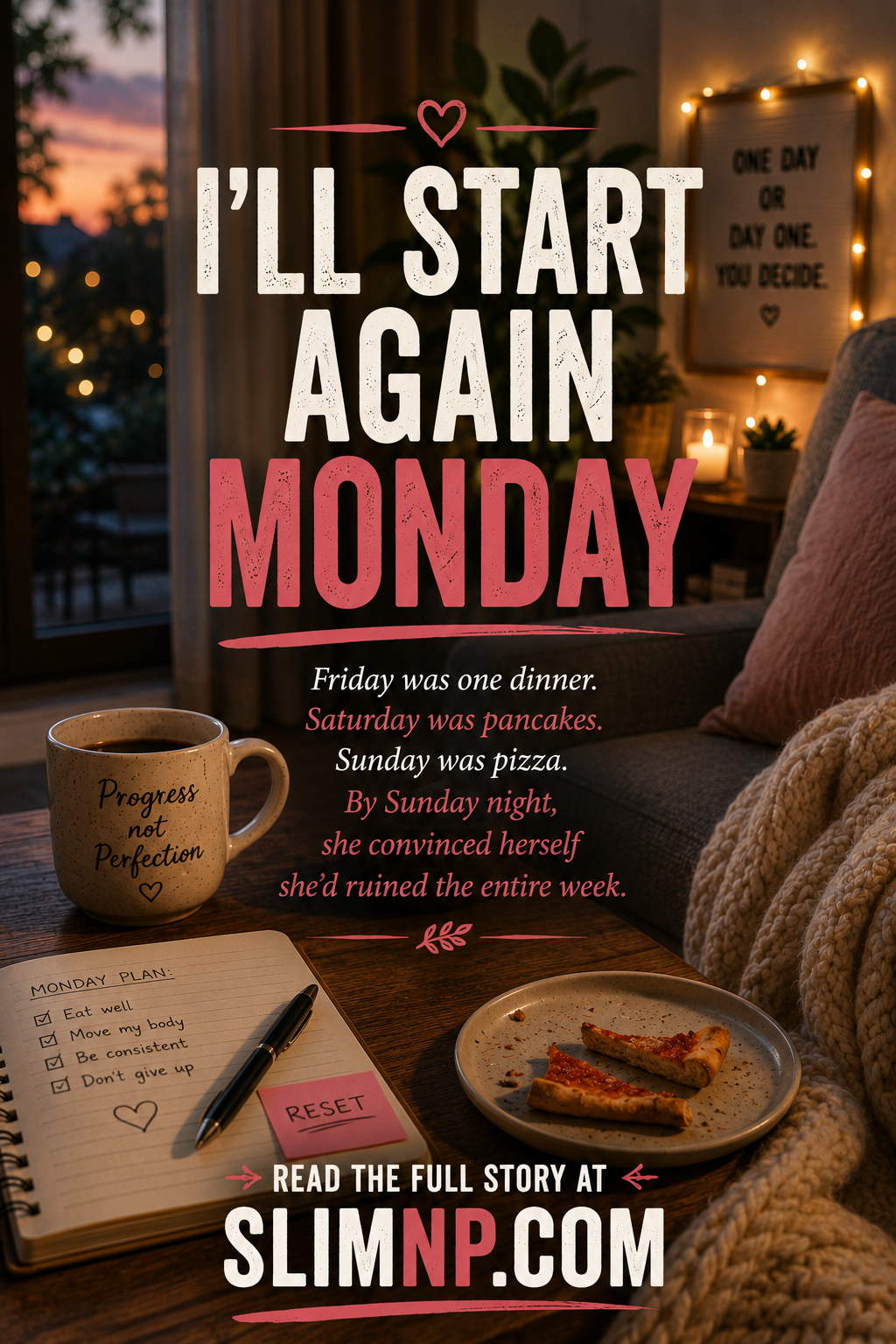
Friday was supposed to be one dinner. Somehow, by Sunday night, Nicole had convinced herself she’d ruined the entire week.
Friday at 5:43 PM, Nicole was doing great.
She knew this because she had been doing great since Monday.
Breakfast at home.
Lunch packed for work.
No random vending-machine snacks.
Three walks.
Two workouts.
Even the container of cookies sitting on the break-room counter since Wednesday had failed to defeat her.
Nicole felt good.
Then her phone buzzed.
Dinner tonight?
Her friend Jenna was back in town.
Nicole stared at the message.
She wanted to go.
But she also knew what happened at restaurants.
There would be appetizers.
Drinks.
Someone would order dessert “for the table,” which was one of society’s more successful methods of pretending dessert belonged to nobody.
Nicole typed:
Yes!
Then immediately opened the restaurant menu.
At 7:15, she arrived with a plan.
Grilled chicken.
Vegetables.
Water.
Maybe one drink.
Very reasonable.
Then Jenna ordered margaritas.
“Just one.”
Nicole looked at the menu again.
She had been good all week.
One margarita wasn’t going to destroy anything.
“Okay.”
Then the chips arrived.
Nicole wasn’t going to eat them.
She ate one.
Then another.
Then she discovered a fascinating property of tortilla chips:
No individual chip ever seemed important enough to count.
Twenty minutes later, the basket was mostly empty.
Dinner arrived.
Nicole ate.
They talked.
They laughed.
Someone ordered churros.
“For the table.”
Of course.
Nicole drove home feeling full but happy.
It had been a good night.
Then she made the mistake.
She opened her calorie-tracking app.
Her peaceful evening became an accounting investigation.
Margarita.
Chips.
Dinner.
Churros.
Nicole estimated everything as accurately as she could.
The number was higher than she’d planned.
Much higher.
She stared at the screen.
Well.
There went Friday.
Then another thought appeared.
There goes the week.
It didn’t make mathematical sense.
But emotionally?
Perfectly reasonable.
She closed the app.
Tomorrow she’d get back on track.
Saturday morning started with good intentions.
Then her husband suggested breakfast.
Nicole almost ordered eggs.
Then she remembered Friday.
She had already messed up the weekend.
“Pancakes.”
The pancakes were excellent.
At lunch, she wasn’t particularly hungry, so she picked at leftovers.
By afternoon, she was hungry again.
She ate some chips.
Then Saturday night became pizza night.
Nicole had two slices.
Then a third.
While putting the leftovers away, she ate half of another slice standing over the kitchen counter.
That half apparently belonged to the cleanup process and therefore existed outside normal nutrition.
Sunday wasn’t much different.
Nicole woke up feeling like she needed a reset.
But Sunday was already Sunday.
And everyone knew diets started on Mondays.
She would enjoy today and restart tomorrow.
This was logical in the same way buying something unnecessary because it was 30% off was logical.
Sunday night, Nicole prepared for Monday like an athlete preparing for competition.
Lunch packed.
Workout clothes ready.
Water bottle filled.
Alarm set.
She even wrote:
RESET
on a sticky note.
Monday morning, Nicole stepped onto the scale.
She immediately regretted it.
Up.
Of course.
She stepped off before allowing herself to stare at the exact number.
Friday had done this.
The margarita.
The chips.
The pancakes.
The pizza.
All her progress was gone.
Nicole skipped breakfast.
By 11:30, she was starving.
She held out until lunch.
By 3:00, someone had opened the break-room cookies.
Nicole walked past them.
Then returned.
She ate one.
Great.
She’d already messed up Monday.
Maybe Tuesday could be the real restart.
And that’s when Nicole noticed something.
She had been here before.
Not at this exact weight.
Not with this exact cookie.
But inside this exact argument.
One choice became one bad day.
One bad day became one bad weekend.
One bad weekend became “I’ll start Monday.”
And if Monday wasn’t perfect?
There was always another Monday conveniently arriving seven days later.
Nicole looked at the remaining half of the cookie in her hand.
Normally this was the moment she’d say:
Whatever. I’ll start tomorrow.
Instead, she did something remarkably boring.
She finished the cookie.
Then she ate the lunch she’d packed.
That was it.
No punishment.
No skipping dinner.
No emergency workout.
No ceremonial restart scheduled for midnight.
She just continued her day.
That evening, Nicole went for her usual walk.
She expected to feel like she was beginning again.
She didn’t.
Because technically, she hadn’t stopped.
Friday dinner was part of her week.
So were Saturday pancakes.
So was Monday lunch.
None of them had been powerful enough to erase everything else.
The realization felt almost suspiciously simple.
Nicole had spent years thinking consistency meant creating long sequences of perfect days.
Maybe consistency actually meant something less impressive.
Returning to normal after the imperfect ones.
The following Friday, Jenna texted again.
Dinner?
Nicole laughed.
Apparently Jenna was now conducting a longitudinal study.
Sure.
Nicole didn’t study the menu beforehand.
She ate normally during the day.
At dinner, she ordered what she wanted.
She ate some chips.
Not zero.
Not the entire basket.
She had one drink.
Someone suggested dessert.
“For the table.”
Nicole laughed.
Naturally.
She had some.
Saturday morning, something surprising happened.
Nothing.
There was no restart.
No guilt-driven breakfast.
No attempt to compensate for Friday.
No declaration that the weekend had been ruined.
She just made breakfast.
Weeks later, Nicole realized that Friday night had taught her something she hadn’t learned during all those perfect Mondays.
Getting off track wasn’t actually her biggest problem.
It was deciding that once she’d stepped off, there was no point getting back on until some imaginary starting line appeared.
And Monday?
Monday had never done anything wrong.
Why the “I’ll Start Monday” Cycle Can Backfire
One higher-calorie meal doesn’t automatically erase several days of consistent habits. Body weight can also rise temporarily after restaurant meals because of changes in sodium, carbohydrate intake, food in the digestive tract, and associated water retention—not solely because of changes in body fat.
A more important problem can be all-or-nothing thinking: interpreting one unplanned choice as evidence that an entire day or week has failed. That mindset can turn one meal into several days of eating differently than intended.
Trying to compensate afterward with severe restriction can create another problem. Excessive hunger may make the next episode of overeating more likely, continuing the cycle.
A more sustainable response is usually much less dramatic: return to your normal eating pattern at the next meal.
There doesn’t need to be a detox, punishment workout, skipped meal, or official restart date.
If eating episodes regularly involve loss of control, significant distress, compensatory behaviors, or persistent guilt surrounding food, consider discussing those experiences with a qualified healthcare professional.
Sometimes consistency isn’t about never getting off track.
It’s about not needing Monday to get back on.
Editor’s note: Nicole and the events depicted in this story are fictional and are used to illustrate common health and weight-management experiences. This article is educational and is not individualized medical advice.
ABOUT THE AUTHOR:
Mark Aquino FNP-C is US board certified and CA state licensed family nurse practitioner, registered nurse, 6 years in healthcare and owner-operator of SlimNP.com, a telehealth and weight loss clinic online. He has a Bachelors and Masters of Science in Nursing and Masters of Health Administration from West Coast University.
A majority of patients he sees have chronic diseases from being overweight such as hypertension, diabetes, high cholesterol and more, lowering quality of life. Many of these diseases can be prevented by simply losing weight. He is on a mission to help people improve their weight before these health complications even happen in the first place.
Social – Follow for more – Follow us on social media:
Email Newsletter |Facebook | Instagram | Twitter/X | Reddit | TikTok | YouTube
| Bluesky | Pinterest | LinkedIn | Medium | Blogger | Quora |
SHOP – Shop Top Recommended Products:
Puravive – for weight loss, natural ingredients to boost fat burn
ElectroSlim – for weight loss, naturally mimics GLP1 effect without medication
…..
Reviewed by: Mark Aquino, MSN, FNP-C (Board Certified Family Nurse Practitioner, Urgent Care NP)
Comments