
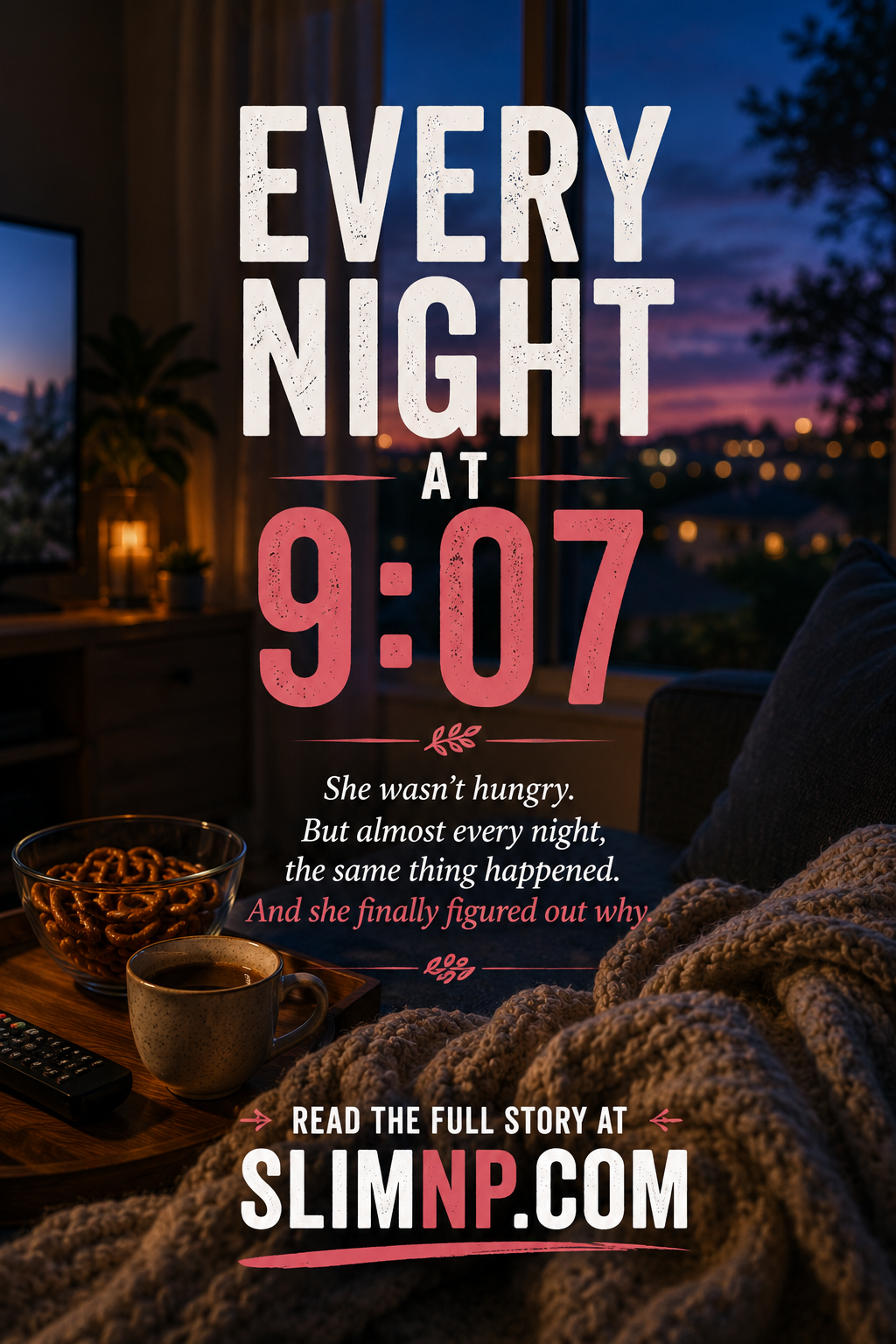
Rachel could turn down donuts at work, ignore the drive-thru, and walk past the vending machine without looking twice. But almost every night, something changed after dinner.
Rachel was excellent at dieting before sunset.
Morning Rachel was unstoppable.
She woke up at 6:30, made coffee, and measured exactly two tablespoons of creamer.
Breakfast was eggs and toast.
Lunch was already waiting in the refrigerator.
She even packed an apple.
By 8:15, Rachel had already made more responsible decisions than she used to make in an entire Saturday.
At work, someone brought donuts.
Rachel walked past them.
Twice.
At noon, her coworkers ordered burgers.
Rachel ate the chicken bowl she’d brought from home.
At 3:00, she wanted something sweet.
She ate her apple.
Morning-and-afternoon Rachel was basically a motivational speaker.
Then she went home.
Dinner wasn’t the problem either.
Rachel made chicken, rice, and vegetables.
She ate at the table.
She was comfortably full afterward.
At 7:30, she cleaned the kitchen.
At 8:00, she took a shower.
At 8:45, she sat on the couch and turned on a show.
And at approximately 9:07 PM, another Rachel clocked in for work.
She wasn’t exactly hungry.
That was the strange part.
But suddenly she remembered there were pretzels in the pantry.
I’ll just have a few.
She poured some into her hand.
Then a few more.
She returned to the couch.
Ten minutes later, she remembered the chocolate.
Apparently remembering food was becoming an evening hobby.
She ate one square.
Then another.
Then she returned to the pantry.
Not because she wanted anything.
She was just looking.
The pantry, apparently, had become an exhibit.
By 10:00, Rachel was annoyed with herself.
It wasn’t the pretzels.
It wasn’t even the chocolate.
It was the pattern.
She could make reasonable decisions for fourteen hours and somehow lose the negotiation during the final two.
Tomorrow would be different.
And tomorrow was different.
Until 9 PM.
Monday became Tuesday.
Tuesday became Wednesday.
Every morning started with determination.
Every night ended with:
Well, I already messed up.
That sentence usually led to more eating.
If she’d already ruined the day, what difference did another handful make?
By Sunday, Rachel had successfully restarted her diet seven times.
She began wondering whether she simply lacked discipline.
But something about that explanation bothered her.
If she had no discipline, how had she walked past the donuts?
Why could she follow her plan at breakfast and lunch?
Why did her supposedly defective willpower work perfectly well until nighttime?
The following week, Rachel tried something different.
Instead of fighting the pattern, she watched it.
Monday night, the urge arrived while she watched television.
Tuesday, the same thing.
Wednesday, she worked late.
She didn’t sit on the couch until almost 10.
The craving arrived at 10:06.
Interesting.
Thursday, Rachel deliberately ate dinner later.
She expected that to solve everything.
At 9:15, she still wanted something.
She wasn’t physically starving.
She just felt like the evening wasn’t complete yet.
Then Rachel realized something almost embarrassingly simple.
For years, television and snacking had happened together.
Movies meant popcorn.
Shows meant pretzels.
Stressful days meant something sweet.
The couch wasn’t making her hungry.
But sitting there seemed to press a button her brain had learned a long time ago.
Couch. Television. Snack.
The sequence had become automatic.
But that wasn’t the only thing she noticed.
On her most difficult nights, Rachel had eaten particularly light lunches because she was trying to “save calories.”
Those evenings felt different.
She wasn’t merely thinking about snacks.
She was genuinely hungry.
She had accidentally created two problems that looked almost identical.
Some nights she ate because the routine told her to.
Other nights she ate because she’d spent the entire day trying not to eat enough.
Rachel experimented.
She stopped trying to make lunch impressively small.
She added more protein and a more substantial afternoon snack.
At night, she made tea before sitting down.
She also created one slightly ridiculous rule:
If she wanted a snack, she could have one.
But she had to put it on a plate and eat it at the kitchen table.
No standing in front of the pantry.
No eating directly from bags.
No mysterious handfuls that apparently didn’t count because nobody had witnessed them.
The first few nights felt strange.
At 9:00, the familiar thought still appeared.
Something sweet would be nice.
Sometimes Rachel decided she actually wanted it.
She put some chocolate on a plate, ate it, and went back to her show.
Other nights, getting off the couch seemed like entirely too much work.
Apparently some cravings were powerful enough to cross the living room but not powerful enough to survive a twelve-foot walk to the kitchen table.
Two weeks later, Rachel hadn’t become a different person.
She still liked chocolate.
She still ate snacks.
Some nights she ate more than she’d planned.
But the strange nightly transformation had mostly disappeared.
More importantly, Rachel stopped describing the problem as:
“I have no willpower.”
That explanation had made her feel guilty without actually telling her what to change.
Her evenings weren’t a character flaw.
They were a combination of hunger, habit, environment, and routine.
One night around 9:10, Rachel opened the pantry.
She looked at the pretzels.
Then she laughed.
“You’re not even what I came in here for.”
She closed the door.
She had actually gone to the kitchen for tea.
For once, 9 PM Rachel and daytime Rachel appeared to be the same person.
Why Nighttime Eating Can Feel So Difficult
Evening eating isn’t automatically a problem, and hunger after dinner doesn’t mean someone lacks willpower. Several factors can make eating more likely later in the day.
Eating too little earlier may leave someone genuinely hungry by evening. Habit also matters: repeatedly pairing television, relaxation, or certain environments with food can create learned cues that trigger the desire to eat even when physical hunger is limited. Stress, fatigue, boredom, sleep patterns, and easy access to highly palatable foods may contribute as well.
Instead of automatically responding with greater restriction, identify what precedes the eating. Adequate meals containing protein and fiber may help when physical hunger is involved. For habitual snacking, changing the routine or environment can make the behavior less automatic. Portioning a desired snack rather than eating directly from its container can also make intake easier to recognize.
Occasional nighttime snacking is common. However, recurrent episodes involving loss of control, unusually large amounts of food, significant distress, compensatory behaviors, or waking repeatedly specifically to eat warrant discussion with a healthcare professional.
Sometimes the useful question isn’t “Why don’t I have more willpower?”
It’s “What keeps happening right before I eat?”
Editor’s note: Rachel and the events depicted in this story are fictional and are used to illustrate common health and weight-management experiences. This article is educational and is not individualized medical advice.
ABOUT THE AUTHOR:
Mark Aquino FNP-C is US board certified and CA state licensed family nurse practitioner, registered nurse, 6 years in healthcare and owner-operator of SlimNP.com, a telehealth and weight loss clinic online. He has a Bachelors and Masters of Science in Nursing and Masters of Health Administration from West Coast University.
A majority of patients he sees have chronic diseases from being overweight such as hypertension, diabetes, high cholesterol and more, lowering quality of life. Many of these diseases can be prevented by simply losing weight. He is on a mission to help people improve their weight before these health complications even happen in the first place.
Social – Follow for more – Follow us on social media:
Email Newsletter |Facebook | Instagram | Twitter/X | Reddit | TikTok | YouTube
| Bluesky | Pinterest | LinkedIn | Medium | Blogger | Quora |
SHOP – Shop Top Recommended Products:
Puravive – for weight loss, natural ingredients to boost fat burn
ElectroSlim – for weight loss, naturally mimics GLP1 effect without medication
…..
Reviewed by: Mark Aquino, MSN, FNP-C (Board Certified Family Nurse Practitioner, Urgent Care NP)
Comments